
A few years ago, most commercial solar procurement discussions focused on module wattage.
Today, buyers increasingly ask a different question:
What cell technology is inside the module?
The reason is straightforward. As module efficiencies continue to converge, the underlying pv cell architecture has become one of the main factors influencing long-term energy production, degradation performance, and project economics.
For commercial buyers, understanding cell technology is no longer a technical exercise. It is part of risk management and investment planning.
A utility-scale project expected to operate for 25 to 30 years will generate millions of kilowatt-hours during its lifetime. Small differences at the cell level can translate into meaningful differences in project revenue.
What Does PV Stand for in Solar Power?
PV stands for Photovoltaic.
Photovoltaic technology converts sunlight directly into electricity through semiconductor materials.
A single photovoltaic cell generates a relatively small amount of electrical power. However, when thousands or millions of cells are connected together, they form systems capable of powering factories, warehouses, commercial buildings, and utility-scale power plants.
This is why the terms solar photovoltaic system, photovoltaic system, and solar PV power plant are frequently used throughout the industry.
From a Single PV Cell to a Utility-Scale Solar Power Plant
Most buyers never purchase individual solar cells.
They purchase modules or complete systems.
However, every solar project begins with the same building block.
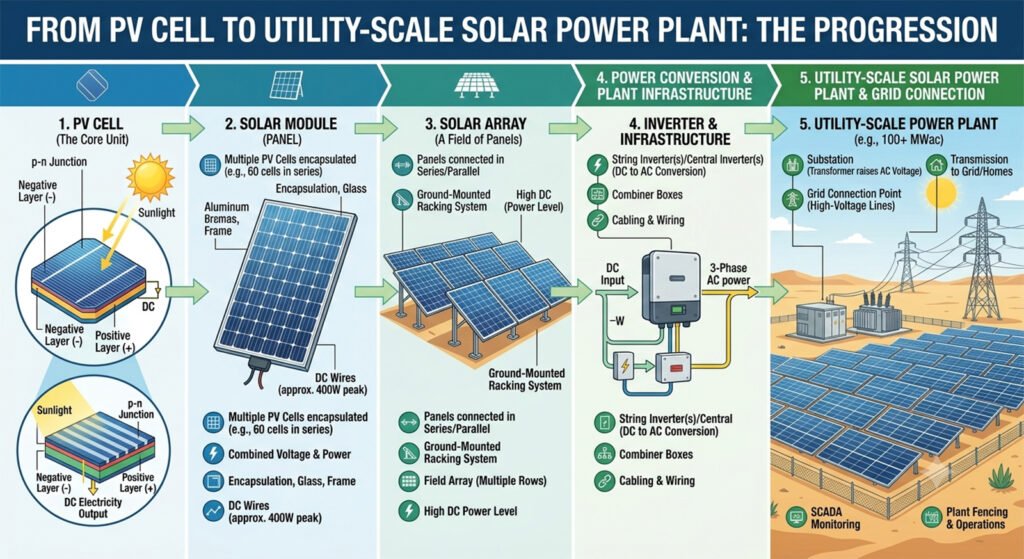
Solar Power Structure
PV Cell
↓
Solar Module
↓
String
↓
Array
↓
Solar PV System
↓
Solar PV Power Plant
A single photovoltaic cell typically produces less than one volt of electricity.
By connecting cells into modules and modules into larger arrays, developers can create systems ranging from residential rooftops to hundreds of megawatts of generation capacity.
How Does a Solar Photovoltaic Cell Work?
Most procurement teams are not interested in semiconductor physics.
What matters is understanding how a photovoltaic cell generates electricity and why certain technologies perform better than others.
Simplified Energy Conversion Process
Sunlight
↓
Photovoltaic Cell
↓
Electron Movement
↓
Direct Current (DC)
↓
Inverter
↓
Alternating Current (AC)
↓
Electrical Grid
This process forms the foundation of every modern solar photovoltaic power system regardless of project size.
Why Buyers Are Paying More Attention to Cell Architecture
Ten years ago, discussions often centered on silicon quality.
Today, most commercial modules use high-purity monocrystalline silicon.
As material differences become smaller, performance improvements increasingly come from cell architecture.
This is why procurement discussions now focus on:
- TOPCon
- HJT
- Back Contact (BC)
rather than simply discussing silicon itself.
For buyers, the question has evolved from:
“What are photovoltaic cells made of?”
to:
“Which cell technology provides the best project economics?”
Commercial Cell Technology Comparison
Mainstream Cell Technologies in 2026
| Technology | Typical Module Efficiency | Market Position |
|---|---|---|
| PERC | 20%-22% | Declining |
| TOPCon | 22%-24% | Mainstream |
| HJT | 23%-25% | Premium Segment |
| BC Technology | 24%-25%+ | Emerging High-End Market |
Source references: Public technology roadmaps and performance reports from IEA PVPS, Fraunhofer ISE, and NREL.
The market transition toward TOPCon is particularly notable because it combines higher efficiency with large-scale manufacturing capability.
For many commercial projects, it currently represents the strongest balance between cost and performance.
Why TOPCon Is Winning New Procurement Tenders
Efficiency alone does not determine procurement decisions.
Commercial buyers also evaluate:
- Production capacity
- Supply-chain stability
- Product availability
- Manufacturing maturity
- Long-term field performance
TOPCon currently benefits from advantages in all five areas.
Typical Procurement Considerations
| Evaluation Area | TOPCon Advantage |
|---|---|
| Manufacturing Scale | Strong |
| Cost Competitiveness | Strong |
| Commercial Availability | Strong |
| Energy Yield | Strong |
| Bankability | Strong |
This explains why TOPCon modules now account for a growing share of global commercial procurement activity.
How Cell Technology Influences Project Economics
For commercial buyers, cell technology matters because it affects energy production.
Consider a simplified utility-scale example.
Example 100 MW Solar Project
| Technology | Relative Energy Yield | Relative LCOE |
|---|---|---|
| PERC | Baseline | Higher |
| TOPCon | +2% to 4% | Lower |
| HJT | +3% to 5% | Lower |
| BC | +3% to 6% | Lower |
Based on publicly available performance studies from NREL, Fraunhofer ISE, and manufacturer field-performance data.
A few percentage points of additional energy production may not sound significant.
Over a 25-year operating period, however, those gains can translate into substantial increases in total energy generation.
The Most Expensive Procurement Mistake
One of the most common mistakes in commercial solar procurement is focusing exclusively on module price.
Example
| Option | Module Cost | Lifetime Energy Production |
|---|---|---|
| Lower-Cost Module | Lower | Lower |
| Premium Module | Higher | Higher |
The cheaper product is not always the lower-cost investment.
Professional buyers increasingly focus on:
- LCOE (Levelized Cost of Electricity)
- Energy yield
- Annual degradation
- Warranty coverage
- Supplier reliability
These factors often have a greater impact on project returns than the initial module price.
What Bankable Buyers Evaluate Beyond Efficiency
Large-scale project developers rarely choose a supplier based solely on efficiency.
Instead, they evaluate overall bankability.
Commercial Procurement Checklist
| Evaluation Factor | Importance |
|---|---|
| Module Efficiency | High |
| Annual Degradation Rate | Very High |
| Manufacturer Financial Strength | Very High |
| Product Warranty | Very High |
| Historical Field Performance | Very High |
| Production Capacity | Very High |
| Certification Compliance | Very High |
This approach reduces long-term project risk.
Certifications Commercial Buyers Expect
Independent certification remains an important part of supplier evaluation.
Key Commercial Certifications
| Certification | Purpose |
|---|---|
| IEC 61215 | Reliability Testing |
| IEC 61730 | Electrical Safety |
| ISO 9001 | Quality Management |
| ISO 14001 | Environmental Management |
| ISO 45001 | Occupational Health & Safety |
| TÜV Certification | Third-Party Verification |
These certifications often provide more confidence than marketing claims alone.
How Huaxin Solar Supports Commercial Procurement
At Huaxin Solar, module recommendations are typically based on project objectives rather than headline specifications.
Commercial buyers often evaluate:
- Installation area
- Target energy production
- Budget requirements
- Project lifespan
- Technology preferences
before selecting a module platform.
This helps align product selection with long-term project economics rather than short-term procurement costs.
Conclusion
The role of the modern pv cell extends far beyond electricity generation.
Cell architecture now influences module efficiency, energy yield, degradation performance, land utilization, and overall project profitability.
As TOPCon, HJT, and BC technologies continue evolving, buyers who understand photovoltaic cell technology gain a significant advantage when evaluating suppliers and technologies.
Before making a final procurement decision, many developers conduct a detailed solar PV panel comparison to evaluate module technologies, project economics, and long-term investment performance.