
When planning a commercial solar project, one of the first questions buyers ask is straightforward:
“What wattage solar panels are typically used in commercial installations today?”
The answer is more complex than it may appear.
Over the last decade, solar module power ratings have increased significantly. Commercial projects that once relied on 250W or 300W panels now commonly utilize modules exceeding 500W. However, selecting the right panel is not simply a matter of choosing the highest available wattage.
Project size, roof structure, installation conditions, and long-term energy goals all influence module selection.
Understanding the average wattage of a commercial solar panel is an important starting point when evaluating modern photovoltaic systems and conducting a solar PV panel comparison.
What Is the Average Wattage of a Commercial Solar Panel in 2026?
Commercial solar projects today typically use modules ranging from 450W to 650W.
While some utility-scale developments deploy products above 700W, most commercial rooftops continue to prioritize installation flexibility and structural compatibility.
Typical Power Ranges by Application
| Application | Common Wattage Range | Primary Selection Reason |
|---|---|---|
| Small Commercial Rooftops | 400W–500W | Easier handling and roof compatibility |
| Industrial Facilities | 500W–600W | Balance of output and installation efficiency |
| Large Commercial Projects | 550W–650W | Higher energy density |
| Utility-Scale Solar Farms | 650W–730W+ | Reduced module count and lower BOS costs |
As of 2026, modules between 550W and 600W represent one of the most common power classes used in new commercial installations worldwide.
Industry references:
- International Energy Agency (IEA)
- Fraunhofer ISE
- BloombergNEF Market Reports
Why Commercial Projects Do Not Always Choose the Highest Wattage
Many first-time buyers assume that larger modules automatically create better project outcomes.
In practice, experienced EPC contractors evaluate multiple factors before selecting a module.
Key Considerations
- Roof loading capacity
- Available installation area
- Transportation efficiency
- Installation productivity
- Maintenance accessibility
- Long-term energy yield
A higher-power module can reduce module quantity, but larger dimensions may introduce additional installation challenges.
This is why commercial solar panel wattage varies significantly between projects.
How Commercial Solar Panel Wattage Has Changed Over Time
Advances in cell technology, module design, and manufacturing efficiency have steadily increased commercial module power ratings.
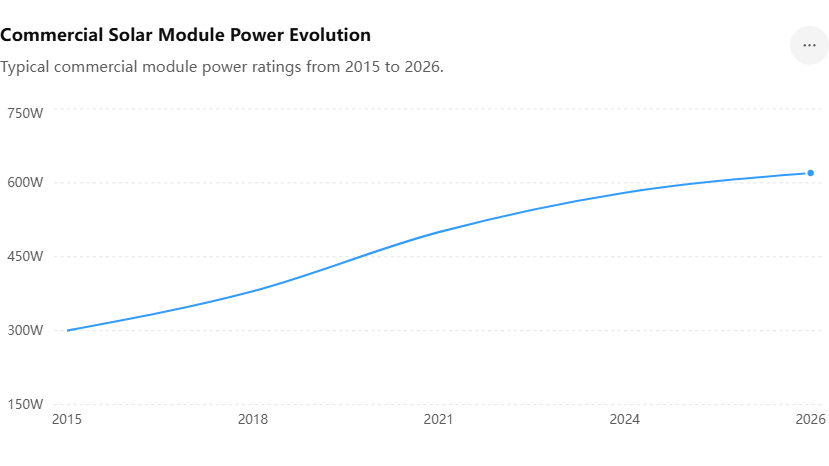
The transition from PERC to TOPCon technology has accelerated this trend, allowing manufacturers to improve efficiency while maintaining reliability and long-term performance.
How Wattage Influences Commercial Solar Project Economics
Higher-power modules can reduce the number of panels required to achieve a target system size. This often leads to lower installation labor costs, fewer mounting components, and reduced electrical balance-of-system expenses.
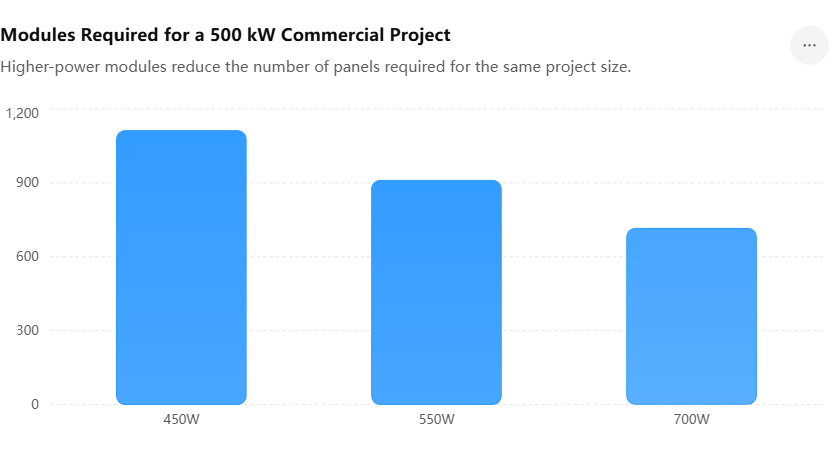
This explains why many developers compare different module classes before finalizing procurement decisions. A detailed solar module comparison often reveals opportunities to reduce project costs without sacrificing performance.
Beyond Wattage: Factors Professional Buyers Evaluate
Experienced procurement teams rarely make purchasing decisions based solely on module power.
Module Efficiency
Higher efficiency allows more electricity generation within limited installation space.
Annual Degradation
Lower degradation rates contribute to higher lifetime energy production.
Warranty Coverage
Commercial buyers increasingly prioritize manufacturers offering long-term performance guarantees.
Technology Platform
TOPCon modules have become a preferred choice in many commercial projects due to their combination of efficiency, scalability, and cost competitiveness.
Certifications That Matter for Commercial Solar Projects
Before purchasing photovoltaic modules, buyers should verify compliance with internationally recognized standards.
| Certification | Why Buyers Check It |
|---|---|
| IEC 61215 | Confirms long-term module reliability under environmental stress conditions |
| IEC 61730 | Verifies electrical safety and compliance requirements |
| TÜV Rheinland Certification | Provides independent verification of product quality and manufacturing consistency |
| ISO 9001 | Demonstrates a controlled quality management system |
| ISO 14001 | Confirms environmental management practices during production |
| ISO 45001 | Verifies workplace health and safety management standards |
These certifications are commonly required for financing approval, insurance compliance, and large commercial project qualification.
Questions Commercial Buyers Frequently Ask
What wattage is most common in commercial projects today?
Modules between 550W and 650W currently dominate new commercial installations.
Is a higher wattage module always better?
No. The optimal module depends on project design, roof structure, installation conditions, and long-term energy goals.
Can commercial projects use utility-scale modules?
In some cases, yes. However, larger module dimensions may create installation or structural challenges.
Should businesses prioritize wattage or efficiency?
Both are important, but efficiency, degradation rates, and warranty coverage often have a greater impact on long-term project returns.
Choosing the Right Module for Your Business
There is no universal answer to commercial module selection. A warehouse rooftop, manufacturing facility, and ground-mounted industrial installation may all require different module configurations despite having similar energy targets.
At Huaxin Solar, many inquiries focus on identifying the most suitable module class rather than simply selecting the highest-power product available. In practice, successful projects are usually those where module specifications closely align with project requirements.
For this reason, many buyers begin with a comprehensive solar PV panel comparison before evaluating specific products and suppliers.
Conclusion
The average wattage of a commercial solar panel has increased significantly over the past decade, with 550W–650W modules now representing the most common range used in commercial and industrial projects.
While wattage remains an important specification, successful commercial solar installations depend on a broader evaluation of efficiency, certifications, reliability, project economics, and long-term performance. By understanding these factors, businesses can make more informed procurement decisions and maximize the value of their photovoltaic investments.